“Fire 90% of HR”: Why the tweet went viral and what it reveals about the future of work
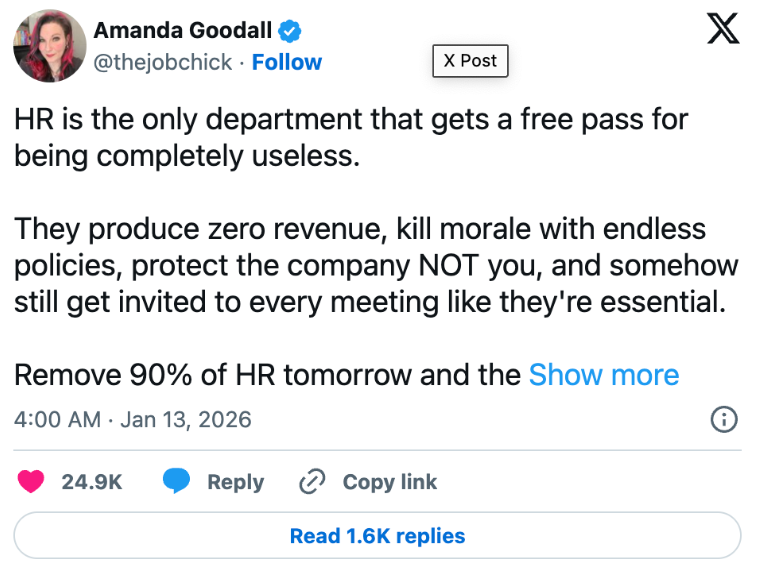
“Remove 90% of human resources tomorrow and the business would run smoother, faster and happier.” »
When leadership consultant Amanda Goodall tweeted that companies should “lay off 90% of human resources tomorrow,” the message didn’t spread because it was polite or balanced. It went viral because it reflected something many employees already feel but rarely express.
On LinkedIn, X and private Slack channels, workers shared the post with a mix of relief and anger. HR professionals pushed back. Leaders debated intentions. But behind the noise was a deeper signal worth examining.
It wasn’t really about firing HR.
It was about broken trust in modern workplaces.
And it’s a problem no business can afford to ignore.
Why employees shared the tweet so aggressively
Viral content in the workplace spreads when it triggers recognition. People don’t share ideas they completely agree with. They share ideas that feel real.
For many employees, HR is now associated with:
- Protect the company, not the employee
- People policies
- Corporate language instead of clarity
- Performance systems that reward compliance, not contribution
When employees face toxic managers, unfair evaluations, or sudden layoffs, HR is often the first step. Too often the response seems legal, distant or scripted.
Over time, this creates the belief that HR exists to manage risk, not people.
The tweet expressed this frustration. His extremity is exactly why he traveled.
The real problem is not HR. It’s power without responsibility
Most employees don’t actually want HR to be eliminated. What they don’t like is authority without transparency.
HR controls hiring processes, promotions, performance reviews, disciplinary actions, and terminations. Yet employees often have little visibility into how these decisions are made or contested.
This creates a dangerous imbalance:
- HR influences careers
- Employees lack meaningful appeal mechanisms
- Decisions seem final and unfair
When power is opaque, trust erodes. The viral reaction was not a rebellion. It was accumulated disillusionment.
“HR protects the business” is no longer a valid defense
A common response to criticism is simple: HR’s job is to protect the business.
This statement is technically correct. He is also strategically out of date.
Modern businesses are not protected by silencing employees, tolerating bad managers, or hiding internal dysfunction. They are protected by:
- Retain the best performers
- Resolve conflicts early
- Building psychological safety
- Maintain employer reputation
In a transparent and mobile labor market, disengagement and attrition cost more than legal disputes. HR that prioritizes paperwork over trust does not reduce risk. It creates it.
The invisible work of HR is real, but invisibility comes at a cost
Critics of HR often ignore the amount of work that goes on behind the scenes.
Effective HR teams:
- Preventing legal crises before they happen
- Managing layoffs under intense pressure from management
- Calmly handle sensitive employee situations
- Design compensation, benefits and compliance systems
- Absorb the emotional labor few others want
Much of the value of HR is intentionally invisible.
But here’s the problem: invisible value still requires credibility. When employees don’t understand what HR does, they fill the void with assumptions. Silence becomes suspicion.
How trust between employees and HR collapsed
This moment didn’t come out of nowhere. It is the result of long-term structural changes.
1. Business language has replaced human language
“Restructurings” have replaced layoffs. “Resources” have replaced people. “Feedback cycles” have replaced conversations.
Linguistic choices signaled emotional distance.
2. HR moves closer to power
As HR has become more strategic, it has also become more aligned with executives. Employee advocacy has weakened.
3. Performance systems have lost credibility
Rigid grades, forced distributions and vague KPIs made assessments arbitrary.
4. Layoffs exposed the gap
Mass emailed layoffs, system lockouts, and vague explanations have permanently damaged trust. HR has become the visible face of invisible decisions.
Why “fire 90% of HR” is a bad conclusion
Eliminating HR would not empower employees. This would further consolidate power upwards.
Without HR:
- The bias increases
- Legal exposure increases
- Conflict resolution disappears
- Whistleblowers lose their protection
- Hiring becomes inconsistent and political
The frustration is justified. The solution is not deletion. It is reinvention.
What HR needs to become to stay relevant
If HR wants to rebuild trust, incremental adjustments will not be enough. The function itself must evolve.
1. Radical transparency
Explain how decisions are made. Share the criteria. Clarify boundaries. Ambiguity destroys trust.
2. True advocacy for employees
HR must be willing to challenge leadership when necessary. Credibility comes from resistance, not alignment.
3. Metrics that really matter
Measure retention, internal mobility, manager quality and re-engagement, not policy completion.
4. Fewer rules, better judgment
Excessive process signals distrust. Strong cultures are built on principles, not textbooks.
5. Human communication in difficult times
Layoffs, performance issues, and conflict require honesty and empathy, not what-ifs.
What this viral moment really reveals
The tweet was not a solution. It was a symptom.
It revealed how many employees feel disconnected from the work systems designed to support them. It showed that institutional roles once considered untouchable are now openly questioned. And it confirmed that trust cannot be restored with surveys, slogans or employer branding.
HR is not obsolete.
But HR that relies on authority without empathy, policies without context, and silence instead of dialogue is.
Employees no longer want to pretend otherwise.
Source- https://www.peoplematters.in/news/strategic-hr/fire-90percent-of-hr-amanda-goodalls-viral-tweet-employees-couldnt-stop-sharing-48022
“Fire 90% of HR”: Why the tweet went viral and what it reveals about the future of work was originally published in Stackademic on Medium, where people are continuing the conversation by highlighting and responding to this story.
Agen Togel Terpercaya
Bandar Togel
Sabung Ayam Online
Berita Terkini
Artikel Terbaru
Berita Terbaru
Penerbangan
Berita Politik
Berita Politik
Software
Software Download
Download Aplikasi
Berita Terkini
News
Jasa PBN
Jasa Artikel
News
Breaking News
Berita