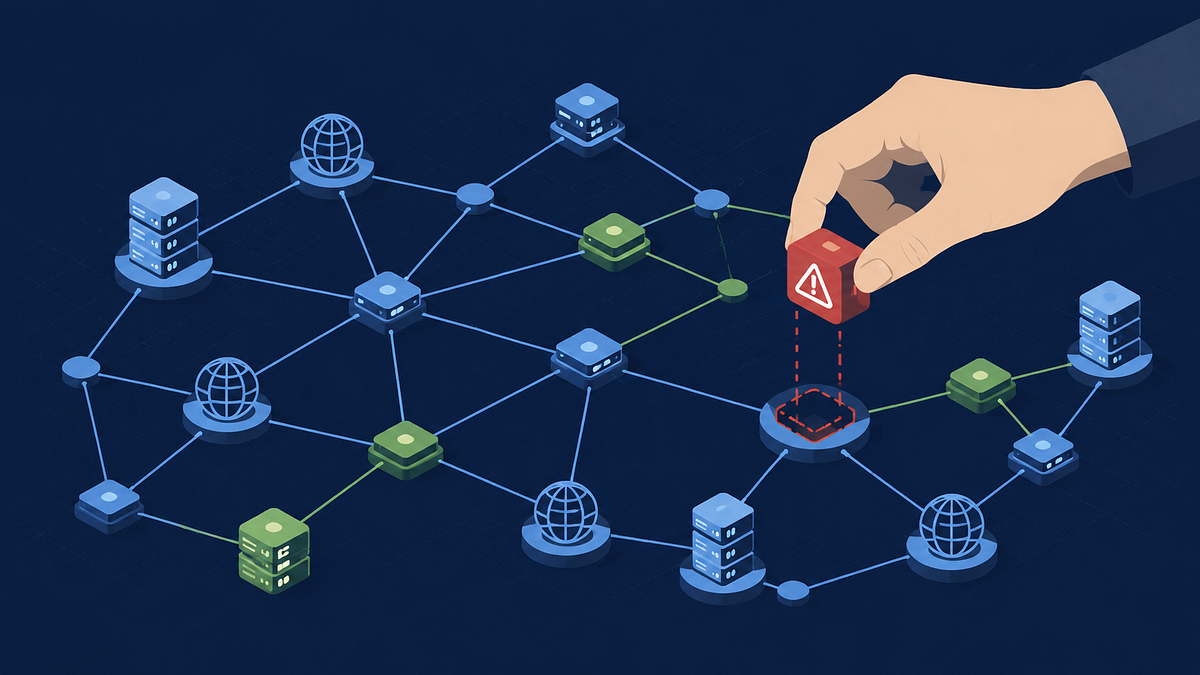
The best DNS products don’t add features. They remove operational risk.

If we examine the post-mortem of the most damaging DNS outages of the last decade, a pattern emerges that should make every product manager in this space uneasy: almost none of them were protocol failures. The protocol did exactly what it was asked to do. The specifications held up. What failed was the operational layer around DNS, the humans, the tools, the change processes, and the assumptions embedded in those three elements.
This model convinced me of something I now consider a product thesis: the best DNS products aren’t the ones with the longest feature lists. They are the ones who systematically eliminate operational risk. Everything else is just noise.
DNS outages are operational failures wearing protocol suits
When a major DNS incident makes headlines, the headlines usually blame the technology. “Incorrect DNSSEC configuration causes service to stop.” “Expired signatures break resolution for an entire country code TLD.” However, read actual postmortems and the story is almost always the same: a change was made, the change was valid syntax, the system accepted it, and the blast radius was not understood until resolvers everywhere started returning SERVFAIL.
DNS is unforgiving in a way that few other layers of infrastructure are. There is no canary deployment for a delegation change. There is no instant rollback when negative caching has already propagated a bad response to millions of resolvers. TTLs mean that your error survives your correction. A misapplied DS record or botched key change does not fail loudly at deployment time. It fails silently, globally and with delay.
This is why I always come back to the same conclusion: the protocol is not the surface of the risk. The change is. And products that only expose the protocol, without influencing how changes occur, pass the risk directly to their customers.
From CLI and APIs to guided operational workflows
The first generation of DNS tools was the zone file and text editor. The second was the API: programmatic, scriptable and a real step forward in automation. But APIs have one property that product teams don’t talk about enough. An API will allow you to do anything, including catastrophic things, with equal enthusiasm and without context.
The evolution currently underway across the industry represents a third step: guided operational workflows. Not wizards that simplify things, but interfaces that encode operational knowledge into the change path itself. What does this look like in practice?
- Show the consequences of a change before it is applied, not after resolvers cache it.
- Group related settings so that an operator configuring rate limiting also sees negative caching behavior because these decisions interact.
- Make settings previously reserved for the API visible, because a setting no one can see is a setting no one audits.
- Provide contextual explanations of concepts like TTL and negative caching at the precise moment an operator makes a decision that depends on them.
The pattern here is subtle but important. None of these features are “features” in the traditional roadmap sense. No sales presentation has resizable table columns. But each fills a gap where operational errors have historically entered the system. The product absorbs the risks that once lived in the operator’s head.
What DNSSEC and registry incidents continue to teach us
DNSSEC deserves special attention because it provides the clearest demonstration of the thesis. Cryptographically, DNSSEC works. Operationally, it has been responsible for some of the most painful outages in DNS history, and the failure mode is almost always the same: a signing or failover operation that was technically allowed but operationally wrong.
Get Dr. Enrique Somoza, D.Sc.stories from in your inbox
Join Medium for free to get updates from this writer.
Well-documented incidents follow a script. A key rollover occurs while stale DS records remain with the parent. Signatures expire because a renewal process is silently blocked. An algorithm switch breaks validation for resolvers that have strictly handled the transition. In all cases, the system did what was asked of it. What was missing was a layer that could say: this change, in this order, at this time, is going to break validation, and here’s why.
Incidents at the register level amplify the lesson because the explosion radius does not correspond to one zone but to all zones below. When a TLD has a signature problem, thousands of organizations that have done nothing wrong go dark simultaneously. What product teams need to remember is not “DNSSEC is hard,” which is where most of the rhetoric ends. The bottom line is that any operation with distributed and delayed failure modes requires safeguards at the product level: pre-change validation, consideration of dependencies, and application of sequencing. Documentation is not a safeguard. A runbook that a human must remember to follow is a single point of failure with additional steps.
Why UX Refreshes Are Reliability Work
This is where I want to push back against a common prejudice. When a DNS vendor offers a dashboard refresh, there’s a tendency in technical circles to shrug their shoulders: aesthetics, not capacity. I think this instinct is wrong, and recent developments in the industry clearly demonstrate this.
Recent dashboard updates on major DNS platforms are good examples of this. The pattern is consistent: Settings that were previously configurable only through the API, things like attack mitigation thresholds, rate limiting, and negative caching behavior, are now moved into the interface where they can be seen and audited. The create and edit flows are being redesigned to consolidate interactive settings. Record management interfaces benefit from advanced filtering, expanded input fields so long values are no longer clipped, and small in-product explanations for concepts like TTL, delivered at the exact moment an operator needs them.
Consider the actual impact of each of these changes on the risk profile. Truncated input fields have caused real incidents: an operator cannot check a value that he does not see. API-only settings create configuration creep that no one notices until an attack tests them. Ungrouped settings mean that interacting settings are changed in isolation. Education in context means that the person making a TTL decision understands the propagation implications at the time of the decision, not after review of the incident.
None of this is cosmetic. This is reliability engineering delivered through interface design. The industry has spent two decades hardening DNS infrastructure against attackers. The hardest problem remaining is hardening it against well-meaning operators at 2 a.m., and this problem is solved in the UX layer.
AI-assisted change validation is the next differentiator
If guided workflows are the current frontier, I believe AI-assisted change validation is next, and will separate enterprise DNS platforms over the next few years.
Here is the gap as I see it. Today, even the best DNS products validate basic syntax and semantics. They will prevent you from entering a poorly formed file. What they won’t do is reason about the intent and radius of the explosion. They can’t tell you that the CNAME you are about to delete is the target of records in three other zones. They can’t tell you that updating your DS record, combined with your current TTLs, opens a validation gap of several hours. They can’t tell you that the pattern of changes you’re making resembles a migration and that migrations of this form historically fail at a specific stage.
These are exactly the judgments that a senior DNS engineer instinctively makes, and exactly the judgments that evaporate when that engineer is on vacation. Large language models, based on an organization’s real-world area data, query analysis, and change history, are well suited to this class of problems: examining a proposed change set, simulating its consequences on the resolution path, and reporting risks in plain language before anything propagates.
The competitive dynamics here deserve to be clearly laid out. Each major DNS platform has comparable protocol coverage. Anycast networks are table stakes. Performance differences are measured in single-digit milliseconds. What is not trivialized is the ability to prevent the failure that could have occurred. The platform that can credibly claim that “our product would have detected this change before shipping” is selling something that no feature matrix captures: fewer incidents, shorter postmortems, and engineers who sleep through the night.
The dashboard I would use
If I were evaluating enterprise DNS platforms today, I would spend less time on the feature comparison spreadsheet and more time on questions like these. What does the product show me before a risky change is applied? What settings exist only in the API, invisible to people auditing the configuration? When a DNSSEC operation is about to break validation, does the product know? Where is the operational knowledge: in the product or in the head of my most experienced engineer?
DNS has been around long enough that the protocol issues have been largely resolved. The products that win here will be those that treat each post-mortem incident as a design requirement and quietly remove the conditions that made the incident possible. No more features. Less risk.
PakarPBN
A Private Blog Network (PBN) is a collection of websites that are controlled by a single individual or organization and used primarily to build backlinks to a “money site” in order to influence its ranking in search engines such as Google. The core idea behind a PBN is based on the importance of backlinks in Google’s ranking algorithm. Since Google views backlinks as signals of authority and trust, some website owners attempt to artificially create these signals through a controlled network of sites.
In a typical PBN setup, the owner acquires expired or aged domains that already have existing authority, backlinks, and history. These domains are rebuilt with new content and hosted separately, often using different IP addresses, hosting providers, themes, and ownership details to make them appear unrelated. Within the content published on these sites, links are strategically placed that point to the main website the owner wants to rank higher. By doing this, the owner attempts to pass link equity (also known as “link juice”) from the PBN sites to the target website.
The purpose of a PBN is to give the impression that the target website is naturally earning links from multiple independent sources. If done effectively, this can temporarily improve keyword rankings, increase organic visibility, and drive more traffic from search results.