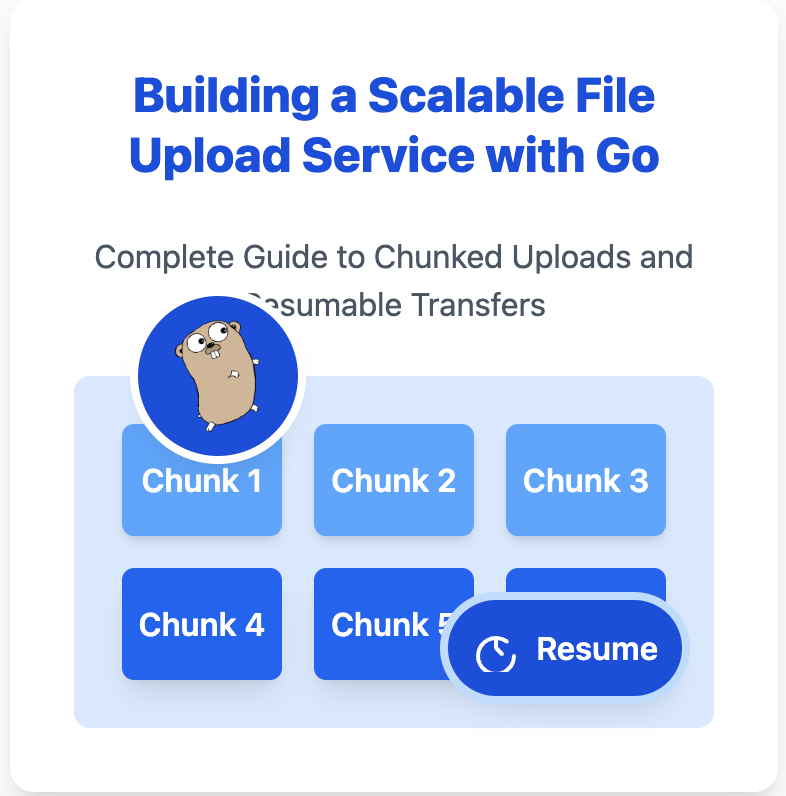
Build an evolving file download service with GB: Complete Guide for Driven Downloads and Sharter Transfers | By Arif Rahman | May 2025

In the current world focused on data, effective file management is crucial for web applications. This complete guide explores how to implement a Production ready file download system Use of Go (Golang) which supports:
- Downloads For large files
- Summary transfers For unreliable networks
- File validation for safety
- Progress monitoring For the user experience
- Restful API With boastful documentation
Downloads of traditional files to a single request are faced with critical limitations:
- Memory constraints: Loading whole files in memory
- Network fragility: Unique failure for large transfers
- Lack of progress monitoring: A bad user experience
- No recovery capacity: Bandwidth wasted on chess
Basic components
1. Configuration layer (config/))
– Centralized environmental management
– Configuration of the dynamic download directory
– Cors and security policies
// config/config.go package config
import (
"os"
"strings"
"github.com/joho/godotenv"
)
var (
AppPort string
AppHost string
UploadPath string
LogPath string
AllowedOrigins []string
)
func init() {
// Load environment variables from .env file
if err := godotenv.Load(); err != nil {
panic("Error loading .env file")
}
// Initialize configuration variables
AppPort = getEnv("APP_PORT", "8001")
AppHost = getEnv("APP_HOST", "127.0.0.1")
UploadPath = getEnv("UPLOAD_PATH", "./uploads")
LogPath = getEnv("LOG_PATH", "./logs")
// Load allowed origins from environment variable
AllowedOrigins = strings.Split(getEnv("ALLOWED_ORIGINS", "*"), ",")
}
// getEnv retrieves an environment variable or returns a default value
func getEnv(key, defaultValue string) string {
if value, exists := os.LookupEnv(key); exists {
return value
}
return defaultValue
}
2. API handlers (handlers/))
– Management of end of rest
– Logic of treatment of songs
– Middleware error management
3. Commercial logic (services/))
– File assembly engine
– Validation of songs
– Storage management
4. Utilitarian layer (utils/))
– Ask for tracing with uuids
– Structured JSON Journalization
– File operations
1. Treatment of intelligent songs
The system implements a sophisticated song management system:
// services/services.go
func HandleFileUpload(file multipart.File, fileName string, chunkIndex int) error {
chunkPath := fmt.Sprintf("%s%s%d", fileName, ".part", chunkIndex)
// Save chunk and check for completion
if chunkIndex == totalChunks-1 {
return CheckAndAssembleFile(fileName, totalChunks)
}
return nil
}
Chunk Workflow:
- The customer divides the file into 1 MB pieces
- Each piece includes metadata:
– Index position
– Total account of songs
– Original file name - The valid server and stores pieces
- The triggers of the final assembly on the last song
Robust recovery capacity prevents double transfers:
// upload.html
function resumeUpload() {
fetch(`/resume-upload?file_name=${encodeURIComponent(fileName)}`)
.then(response => response.json())
.then(data => {
currentChunkIndex = data.chunk_index;
// Continue transfer from last chunk
});
}
Recovery process:
- Customer requests Download status
- Servers analyzes for existing pieces
- Returns the latest successful song index
- The customer resumes the next game
Multilayer safety validation:
// middleware/file_upload_middleware.go
func detectFileType(header []byte) string {
if bytes.HasPrefix(header, []byte{0x89, 0x50, 0x4E, 0x47}) {
return "image/png"
}
// Additional magic number checks...
}
Validation layers:
- File signature (magic number) verification
- Song size limits (1 MB)
- Total pieces of pieces of pieces (100)
- Mime type white list
Visual feedback system:
<div id="progressBar">
<span id="progressText">0%</span>
</div><script>
function updateProgressBar() {
const progress = Math.round((currentChunkIndex / totalChunks) * 100);
progressBar.querySelector('span').style.width = progress + '%';
}
</script>
Monitoring features:
- Percentage of completion
- Visual progress bar
- Granularity in the pieces
- Websocket integration option
Downloads of traditional files to a single request are faced with critical limitations:
- Memory constraints: Loading whole files in memory
- Network fragility: Unique failure for large transfers
- Lack of progress monitoring: A bad user experience
- No recovery capacity: Bandwidth wasted on chess
- Simultaneous treatment
– Goroutine -based parallel handling
– Channel -based synchronization - Memory efficiency
– Flow processing (no full loading of files)
– Fixed size pads (pieces of 1 MB) - Network resilience
– Rely automatic with backoff
– Verification of the sum of control
– Keep-alive connection
Recommended improvements:
- Implement JWT authentication
- Add the rate limitation
- Develop the administrative dashboard
- Create customer SDKs
The complete source code is available on GitHub.
Before leaving:
Grpahic Designer
Motivation
Pendidikan
Pendidikan
Download Anime