Compliance requirements: what do they really ask?
HIPAA, RGPD, PCI DSS, SOC 1/2/3 → What it means, why they count and what you should really know as a developer.
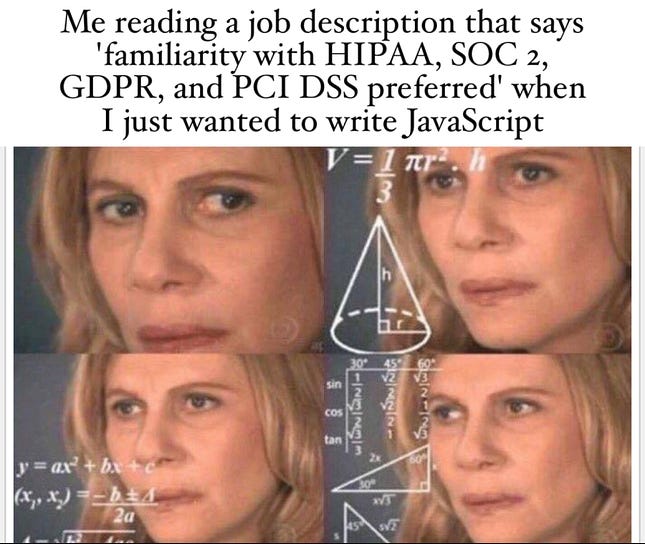
Non-liability clause: If you’ve already read a job description that says that “familiarity with compliance executives like Hipaa, SOC 2 or GDPR is a plus” and has thought: “I am a development, not a lawyer”, it’s your unofficial guide to know just enough dangerous … in the right direction.
🧾 First of all, what does “conformity” mean?
Simplify it.
Compliance means playing according to the rules. The rules defined by governments, industries or customers to protect data, guarantee confidence and avoid prosecution. These rules vary depending on the type of data you manage (health files, financial transactions, user emails) and Or Your users are located.
When you see the conformity mentioned in the work descriptions, it is not because they want you to memorize the legal framework, it is because they want engineers who understand what means creating systems that manage sensitive data in a responsible manner.
Think about it this way:
Security is to protect data.
Compliance is to prove that you protect it … and do it well.
And here is the botter… compliance is not a unique certification. It is a process in progress. You are not content to “become compliant” and call it one day, you keep it permanently through the way you record the activity, manage incidents, design access controls and even how you deploy new features. Compliance is cooked in the Daily behaviors high confidence engineering teams
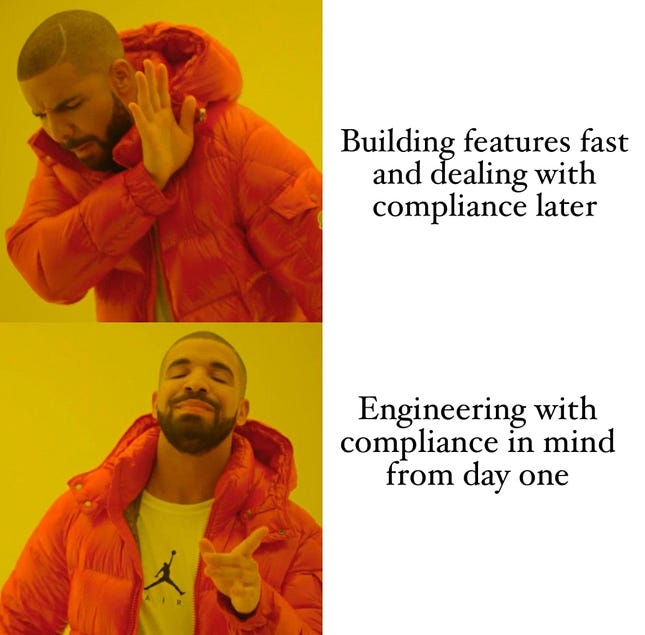
🏥 HIPAA → For health care applications that manage medical data
Hipaa represent the Portability and Health Insurance Act. It is an American law that protects Patient health informationEverything, from medical records and test results on appointments and insurance identifiers.
If you build or maintain systems that store or transmit Phi (Protected health information), HIPAA applies.
What is needed:
- Encrypt phi at rest and in transit
- Access control (only authorized users can display / modify data)
- Journalization that accessed what, and when
- A process of reporting and managing data violations
- Sign a commercial associate agreement (BAA) to your cloud supplier
Why is it important:
HIPAA violations can cost up to $ 1.5 million per year per category of violation. But beyond fines, that’s about Patient confidence. No one wants their medical history to be disclosed because you have forgotten to light the encryption.
🌍 GDPR → the global ordeal for confidentiality
GDPROr General Data Protection Regulations,, is a regulation of the European Union, but it affects anyone who collects or processes data from I citizensIt doesn’t matter where your business is based.
What is needed:
- Obtain clear consent before collecting user data
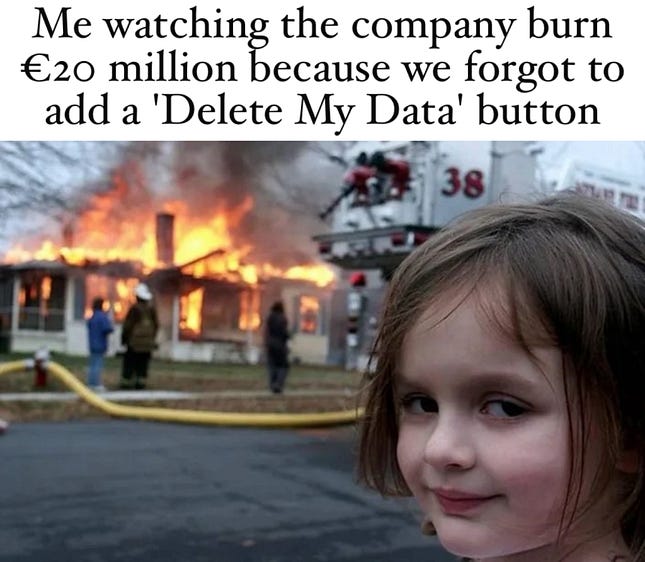
- Let users delete, update or export their data (hello, “Download my data”)
- Transparency on the use of data (privacy policies are important)
- Do not collect data “simply because” … the goal must be defined
- Report violations within 72 hours
Why is it important:
Fines can reach up to 20 million euros or 4% of world annual income, depending on the highest. But even if you are not in the EU, the GDPR has become the default confidentiality bar that users and companies are now waiting for a global scale.
💳 PCI DSS → If you manage credit cards, you are there
PCI DSS represent Data security standard for the payment card industry. It is a set of rules defined by companies such as Visa, Mastercard and Amex to protect data from credit cards.
If your application directly accepts payments, stores card information or even key the payment process, PCI DSS applies.
What is needed:
- Strong encryption for card data
- Regular vulnerability scans and penetration tests
- Firewall, antivirus and secure authentication
- No CVV storage after a transaction
- Strict access control to card holder data
Why is it important:
If you are not in accordance with PCI and you suffer from a violation, your business could face heavy fines, lose the ability to treat payments or be forced to work with an expensive third -party listener. This is why many startups use services like Stripe and Flutterwave… They unload the compliance burden by design.
📜 SOC 1, SOC 2 and SOC 3 → Trust reports for the SaaS and service providers
Sock represent System control and organization. SOC reports come from AICPA (American Institute of Certified Public Accountants). They are designed to help companies trust the systems you are running, especially if you offer a cloud -based product.
Brisons- them:
✅ SOC 1 → Precision of financial reports
SOC 1 focuses on Internal checks on financial information (ICFR).
If your product affects financial statements Like payroll software, billing platforms or accounting systems … SOC 1 conformity shows that you are doing well.
This is especially important for listeners and financial teams.
🔒 SOC 2 → Safety, availability, and more
SOC 2 is the one you will see the most SaaS work descriptions.
It is a question of proving that your systems are:
- Secure
- Available
- Maintain Data integrity
- Respect Confidentiality
- Maintain Confidentiality
SOC 2 is not a control list, it is a long -term commitment. You implement processes (such as access controls, response to incidents, audit trails), then obtain checks by a third party. There are two types:
- Type I: “We have the right policies in place.”
- Type II: “We followed them in a coherent way for 3 to 12 months.”
📣 SOC 3 → The public confidence badge
SOC 3 is essentially SOC 2 Type II … but Summary for public sharing.
It is a brilliant report that you can put on your website to say, “Hey, we are safe. Here is the proof.”
If you are in a development team that cares about availability, audit newspapers or at least access to privileges, you are already working on things that matter for Soc 2.
🛠 So … why do developers need to care?
Because pilot compliance How we build things.
When the post descriptions require “Familiarity with compliance executives”, “ They don’t ask you to be a legal jargon expert … they ask if you know how:
- Enter the data correctly
- Limit who can see what
- Keep the audit newspapers
- Respect user confidentiality
- Work in environments where Security and responsibility are not optional
It’s about engineering maturity. The teams that build with conformity to the mind are not only dispatched quickly … they ship in a responsible manner.
In addition, developers are often the first line of defense. You are the one who decides to house data sensitive to the console. You write the function that stores user information. You configure the S3 bucket and decide whether it is public or private. Compliance does not live in isolation, it is in code, infra, architecture choices and the culture that you help to create.
💼 Why it appears in each job description
Modern companies in particular in health care, fintech and corporate Saas cannot afford to ignore compliance. It’s not just Avoid finesIt’s about Signe confidence Users, partners and investors.
When a JD mentions HiPAA, SOC 2 or GDPR, he does not say “go to follow the right”. They say:
“We need people who care about how systems are built … not only that they work, but they work in complete safety and transparent. “”
And beyond, it is a signal that the company takes security and the scale seriously. This means that they are probably working with real users, real data and real partners who require responsibility. If you want to be one of the systems that last Not just the MVPs that send and break, understanding compliance will always distinguish you.
Tl; DR: Compliance does not concern the legislator → This is responsible engineering
- Hipaa Protects patient data
- GDPR Protects user confidentiality
- PCI DSS Protects credit card information
- 1/2/3 SOC strengthens confidence by auditability and security
You don’t need to be a compliance agent. But you should know what are these executives, how they appear in the systems you build and why your next commitment could be part of an audit one day.
🎉 If you have arrived so far, you are the real MVP 👑
The next time you see a job post that mentions compliance, you will not have at Le Google, you will know exactly what they are asking for and why it is important.
Press this click button 50 times 👏👏👏 If that helped give meaning to the compliance jungle. And if you have already had to retro-adjust SOC 2 the controls in an application that has not been built with conformity to the mind … Let’s talk in the comments. 🚀
✍️ PS… I write articles like this to live (and I am available)
If you have found this article useful, insightful or simply refreshing, I do more. I am available for technical writing concerts, in particular around development tools, devops, cloud infrastructure, security or everything that must be “engineer” to “human”.
Whether it is blog content, product documentation or guides like this …
Let’s discuss. You can reach me my abandonment a private note on this article or on Linkedin
Please be part of the community
Before leaving:
- Make sure type And follow The writer ️👏Thousands
- Follow us: X | Liendin | YouTube | Bulletin | Podcast | Differ | Tic
- Start your own free blog on ai on different 🚀
- Join our community of content creators on Discord 🧑🏻💻
- For more content, visit Plainengish.io + Stackademic.com
Compliance requirements: what do they really ask? was initially published in Stackademic on Medium, where people continue the conversation by highlighting and responding to this story.
Grpahic Designer
Berita Olahraga
Lowongan Kerja
Berita Terkini
Berita Terbaru
Berita Teknologi
Seputar Teknologi
Drakor Terbaru
Resep Masakan
Pendidikan
Berita Terbaru
Berita Terbaru
Berita Terbaru